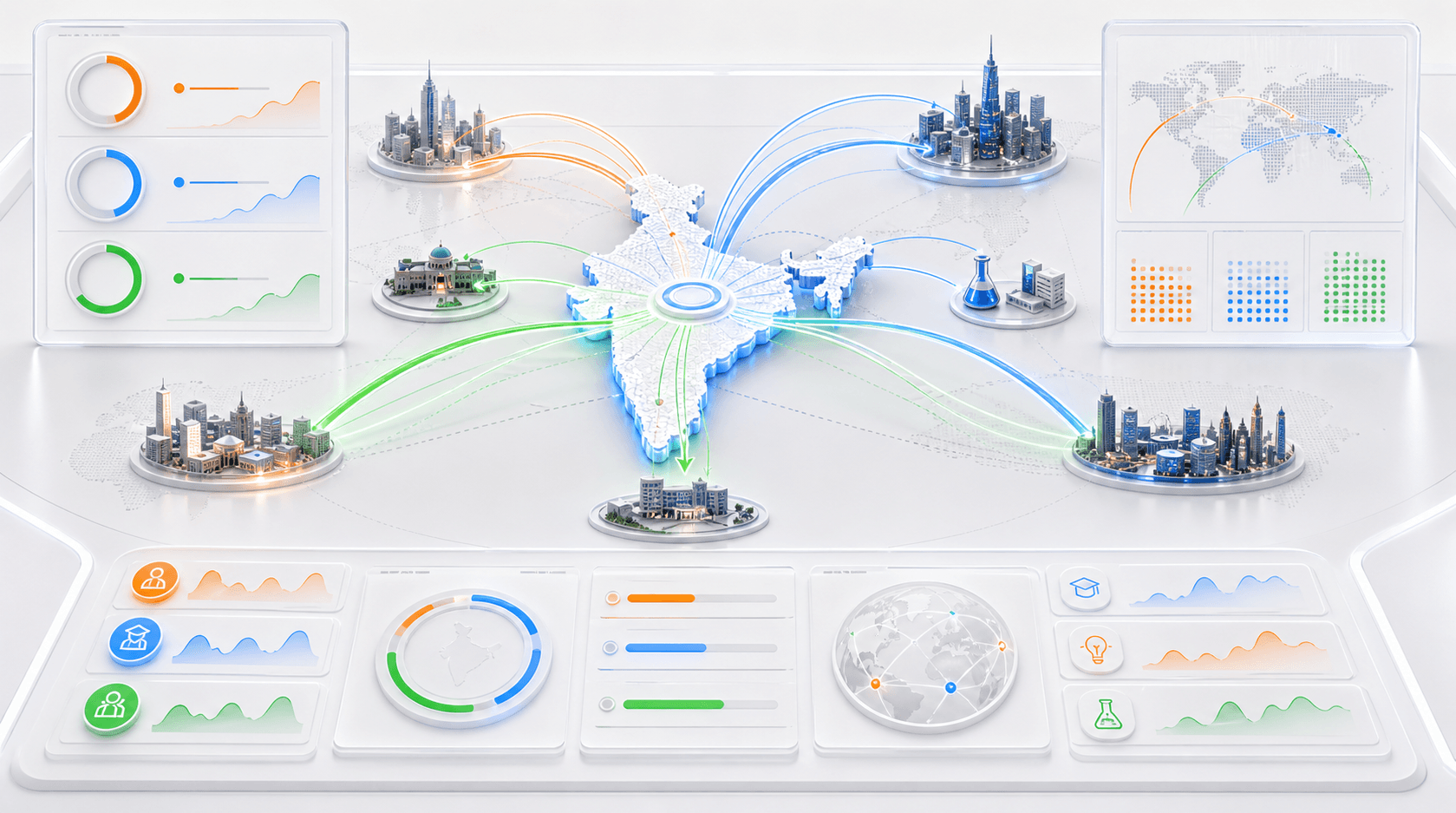
Brain drain, brain gain, and brain circulation for India.
A research-backed view of skilled migration with a Pune and Maharashtra lens, built from the multi-dimensional brain drain report shared for NoBrainDrain.
India's challenge is no longer a simple one-way brain drain story. Highly skilled professionals still leave in STEM, healthcare, R&D, IT and academia, but return migration, diaspora engagement, remittances, knowledge transfer and investment now create a more complex brain-circulation picture.
Substantial outflows continue because of limited high-quality domestic opportunities, intense competition, stronger research ecosystems abroad and quality-of-life pull factors.
The cost is not only emotional or symbolic. It includes lost public investment in education, foregone GDP contribution, weaker IP creation and critical sector skill gaps.
The opportunity is to convert mobility into circulation by building a stronger domestic ecosystem and structured diaspora engagement pathways.
02
Pune and Maharashtra lens
Pune is a useful pilot geography because it combines IT, manufacturing, automotive, education and research density. The research flags that Pune likely contributes meaningfully to national skilled outflows, especially in IT and engineering, but also suffers from weak sub-national migration tracking.
Pune has high industry presence and talent aspiration in IT/ITeS and related emerging technology sectors.
The city also has strong academic density, making it ideal for university-industry innovation pilots.
Local interventions around labs, applied research, industry projects, quality of life and skill alignment can complement national policy.
03
Strategic recommendations
NoBrainDrain converts the research recommendations into an executable innovation infrastructure model for cities, CSR partners, institutions and industry bodies.
Strengthen domestic opportunity quality through applied research labs and industry-linked problem statements.
Retain and attract talent in critical sectors such as AI/ML, cybersecurity, advanced manufacturing, healthcare and R&D.
Create better data systems through a Talent Impact Ledger that can track outflows, inflows, ecosystem strength and net impact.
Use Pune/Maharashtra as a regional prototype before scaling to multiple city innovation hubs.
Next step
Convert the document into an operating pilot.
Use this page as the public-facing explanation layer, then connect it with CSR partners, institutions and city-level industry problems.